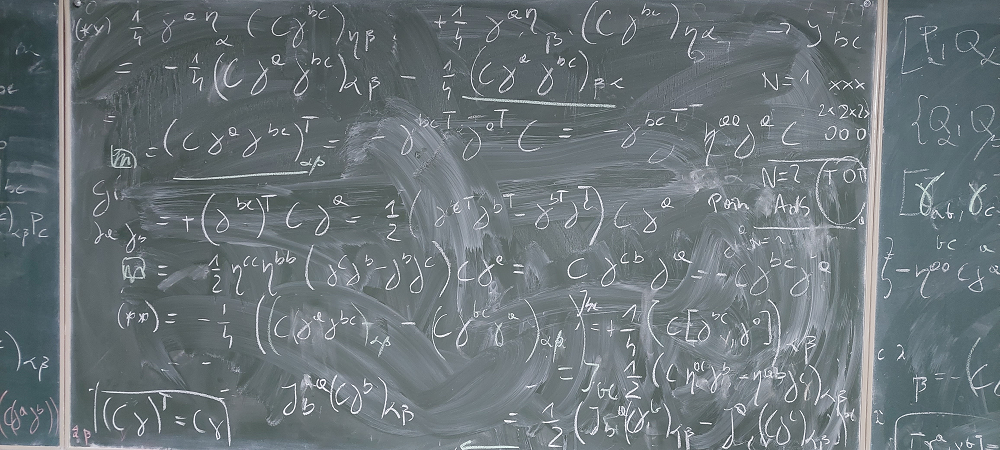
Superalgebras for Supergravity
Our project focused on identifying superalgebra structures that describe intrinsic symmetry. Starting from the Poincaré and Anti-de Sitter (AdS) frameworks, we extended these primary structures using the resonant construction, introducing additional symmetry generators. We then analyzed millions of superalgebra candidates to identify generator configurations that follow the pattern of Poincaré- or AdS-like superstructures. The viable superalgebras were required to satisfy the Jacobi identities.
In Eur. Phys. J. C 82 (2022) 3, 254, we derived symmetry algebras using an efficient pattern-based computational method implemented in Wolfram Mathematica. These supersymmetric extensions go beyond the standard Poincaré and AdS algebras by incorporating additional bosonic generators of Lorentz-like and translation-like type, alongside the standard Lorentz and translation generators. Our analysis covered all cases with up to two fermionic supercharges. The resulting classification included both previously known examples and a large number of new ones. The list is complete for all superalgebras containing up to two Lorentz-like, translation-like, and supercharge-like generators. Among the 667 superalgebras identified in the most general class, 264 are suitable for direct supergravity construction. Each of these defines a unique supergravity model through its corresponding Lagrangian, and we illustrated this by presenting one explicit example.
In Phys. Lett. B 833 (2022) 137366, we introduced a new superalgebra for N=2, D=3,4 supergravity with an additional U(1) generator. This structure is rooted in the so-called Soroka–Soroka algebra and is generated by Lorentz, Lorentz-like, translation, and T generators, together with two supercharges. For this generator content, it is the unique possible realization. We also constructed the corresponding three-dimensional Chern–Simons supergravity model and discussed its physical relevance.
Funding: [place for funding information]
References:
Eur. Phys. J. C 82 (2022) 3, 254
Acta Phys.Polon.Supp. 16 (2023) 6, 11
Phys. Lett. B 833 (2022) 137366
Collaborator: Remigiusz Durka