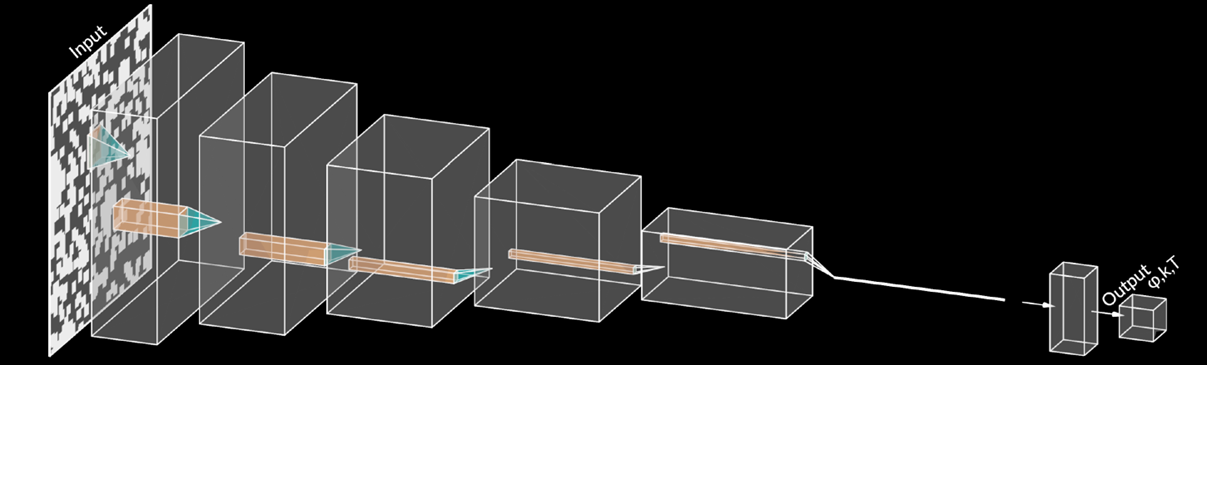
Deep learning in porous media
Our project focused on applying deep learning methods to predict the key transport properties of porous media directly from their geometry. In the first study, we showed that convolutional neural networks can accurately infer porosity, permeability, and tortuosity from two-dimensional images of porous structures generated and validated with lattice Boltzmann simulations. The approach made it possible to recover relations between these macroscopic transport parameters and compare them with empirical estimates.
In the subsequent study, we extended this framework to diffusion in porous media. Using CNN-based models and U-Net architectures, we predicted porosity and effective diffusion coefficients, and reconstructed steady-state concentration fields for two distinct classes of media: sand-pack-like systems and geometries inspired by the extracellular space of biological tissues. The results showed that geometry-based deep learning can successfully capture diffusive transport, while also revealing the limits of transferability between different porous-media classes for scalar transport coefficients and the stronger generalization of concentration-field reconstruction.
Together, these works demonstrated that deep neural networks can serve as efficient surrogate models for complex transport phenomena in porous materials, linking microstructure to macroscopic observables relevant to physics, engineering, and biological applications.
Funding: [place for funding information]
References:
Sci Rep 10, 21488 (2020)
Sci Rep 13, 9769 (2023)
Collaborators: Maciej Matyka, Dawid Strzelczyk