Polarization asymmetries in neutrino scattering off nucleons
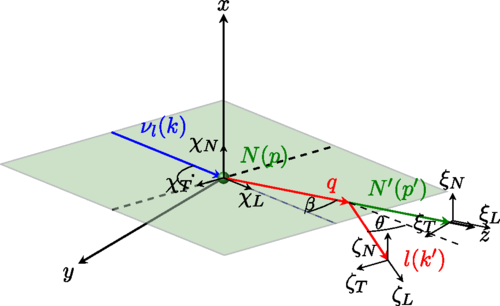
Our project focused on investigating the information content of polarization asymmetries in neutrino scattering off nucleons. The main objective was to determine how spin-dependent observables can improve our understanding of nucleon structure and of the mechanisms governing neutrino–nucleon interactions in both charged-current and neutral-current processes.
For quasielastic charged-current scattering, target-spin as well as double- and triple-spin asymmetries were studied for the first time. We showed that double- and triple-spin asymmetries carry valuable information about the axial structure of the nucleon and provide particularly sensitive observables for determining the nucleon axial form factor.
For single pion production, we investigated the role of spin observables in disentangling the resonant and non-resonant contributions to neutrino–nucleon cross sections. Our results demonstrated that target-spin asymmetries and recoil nucleon polarization contain nontrivial information about the interference between resonant and non-resonant amplitudes. In particular, these observables can reveal both the relative phase between the two contributions and details of the non-resonant amplitudes themselves. We also studied the sensitivity of spin asymmetries to the parameters of the weak N–Delta(1232) transition model.
In a more recent study, we extended this analysis to neutral-current elastic and inelastic neutrino and antineutrino scattering off polarized nucleons. We showed that spin asymmetries can help distinguish neutrino- from antineutrino-induced processes, encode information about the target type, and provide new insight into the resonant–nonresonant pion-production mechanism.
Funding: [place for funding information]
References:
Acta Phys. Polon. B 48 (2017) 2219
Phys. Rev. D 97, 013001 (2018)
Phys. Rev. D 99, 053002 (2019)
Acta Phys. Polon. B 50, 1771 (2019)
Phys. Rev. D 101, 073002 (2020)
Phys. Rev. D 104, 033005 (2021)
Phys. Rev. D 108, 093002 (2023)
Collaborator: Beata Kowal